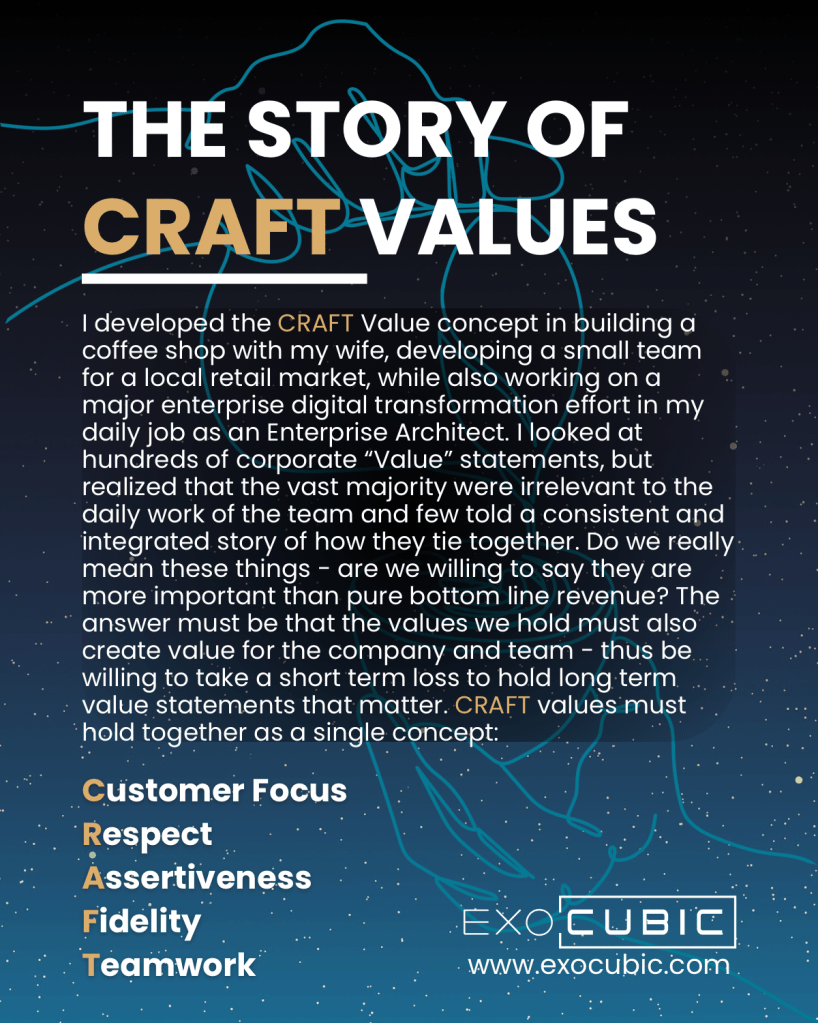
I recently gave an interview with a government project office on applying Value Streams in complex systems architectures. It made me think about the connection between value streams as an architectural concept and value statements as an element of organizational dynamics. Corporations often have value statements. Most of them are meaningless. Allow me a few minutes to walk you through my journey as a Software Architect on how I discovered a formula to craft meaningful value rather than platitudes no one cares about.
(Originally published January 16th 2025, updated August 16th 2025)
Value Statements and Value Streams
Corporate value statements are typically called out as being very important in setting company culture on the one hand and, after a scandal that shows they were a farce, become a rallying cry for customer and employee rights on the other. Being an Architect, I have always seen them as an intrinsic element of organizational design. While I have drawn from several sources over the years, I like how Project Management Institute (PMI) defines Value Streams this way:
A value stream is the set of actions that take place to add value for customers from the initial request through realization of value by the customers.
https://www.pmi.org/disciplined-agile/process/value-streams
So how do you get value creation incorporated into the core of who you are as an organization? Well, for starters, let’s be honest that the core elements of most corporate value statements are about protecting the shareholders and not the whole ecosystem of customers, users, neighbors, and owners.
What are the CRAFT Values?

Customer Focus

The customer is not always right. The customer is, however, always the customer! According to Bill Aulet, author of Disciplined Entrepreneurship and professor at MIT Sloan school of management, the one necessary condition for any company is a paying customer. This is slightly different for non-profits, but is simply more complex as the “payor” and the recipient of services are separate, but is that (really) any different than insurance companies? The motivation is in many cases different (profit), however there are many kinds of non-profit fee based services- so someone is still receiving. The role of someone receiving the services rather than the organization, providing them creates a special relationship that is not like friend, Family, Neighbor, or even coworker.  Corporate values must hinge on this value delivery.
Respect
Respect is a key element that should understand every aspect of our lives. However, it is often challenging to define in many cultures as it varies so broadly in how it is expressed, felt, and received. If we are going to hold to any corporate values, we must understand the context in which those values are received and understood, which makes Respect not only a value for how we share spaces and communicate boundaries, but also how we resolve issues. Think about an end user license agreement, have we been respectful of those people that we are committing to sign it? Simplicity is a form of respect in complex negotiations. The same is true for a customer who experience experiences any formal problem with our products. Respect must also extend to our community, even our competitors. If we expect to be respected, we must be respectful. 
Assertiveness
Find a problem – fix a problem! This is where the whole set of CRAFT values starts to pivot from individual responsibility to a share organizational culture. People tend to fix only the problems that are assigned to them, and assertiveness is often times quashed by pride, bureaucracy, certain kinds of structure, or any variety of cultural dynamics that have people sit back and watch rather than step forward and take action. If we want to create a culture that is continuously improving, we must start by rewarding the assertiveness of our team. We also have to recognize the assertiveness comes with a certain propensity to make mistakes. So training assertiveness into the culture creates opportunities for mentorship, opportunities for processes to ensure that someone attempting to fix a problem doesn’t create another problem (like regression, testing and software).
Fidelity
Teamwork

The Whole CRAFT Story
 Exocubic