[Editorial update: I wrote this article the morning after learning about the incident. I should have taken the time to realize that I was in the shock and anger stage of grief. I should have written this first, now that I have had a chance to process a little how my heart is broken in 67 places.]
Last night, on the evening of January 29, 2025, a tragic mid-air collision occurred over the Potomac River near Ronald Reagan Washington National Airport (DCA). An American Airlines Bombardier CRJ700 regional jet collided with a U.S. Army Sikorsky UH-60 Black Hawk VIP “Gold Top” helicopter, resulting in the likely loss of all 67 lives on board both aircraft. My heart and prayers are with the families and first responders; as of this morning there have been no reported survivors as I keep tabs on the news, writing this from my hotel in DC, and assuring my own family of my safety with my own flight out of DCA this evening cancelled. The National Transportation Safety Board (NTSB) is still investigating the root cause; however, one glaring question looms over this tragedy: Did the Army helicopter have Automatic Dependent Surveillance–Broadcast (ADS-B) installed?
As someone who has worked extensively in Army Aviation and modular avionics, I can say with certainty that this is not a new issue. For over a decade, we have struggled to secure consistent funding to bring Army aircraft up to modern civil navigation standards. Let me be clear here, those of us in Defense Aviation understand that we have our core mission as Operational Navigation in contested environments and not only peacetime civil environments – that said, we share the same airspace the vast majority of the time. While that means that we often have to make challenging decisions about budgets in peacetime, the issue of being able to rapidly upgrade technology is the same at it’s core – an integrated business and technical approach for modular and open systems.
Despite regulatory requirements, program successes, and proven cost-effective solutions, a significant portion of the Army aviation fleet still lacks modern ADS-B capability, creating unnecessary risks for both military and civilian air traffic. I have often been in my seat on approach to DCA, staring out the window watching the Black Hawks flying up and down the Potomac, thinking to myself “I wonder when we are ever going to fix this ADS-B issue?” I find that my passion is tempered slightly by other budgetary and operational needs – I never wanted to sound like I was making a big deal about something that we all knew needed to be fixed and were patiently waiting for a chance to solve. Surely it will be in the budget this year, we keep telling ourselves. This is not a new issue, the GAO published a report 7 years ago entitled, “Urgent Need for DOD and FAA to Address Risks and Improve Planning for Technology That Tracks Military Aircraft,” that addressed the specific lack of ADS-B in Military Aviation.
The Goldilocks Zone of Safety – Too Slow Is Also Dangerous
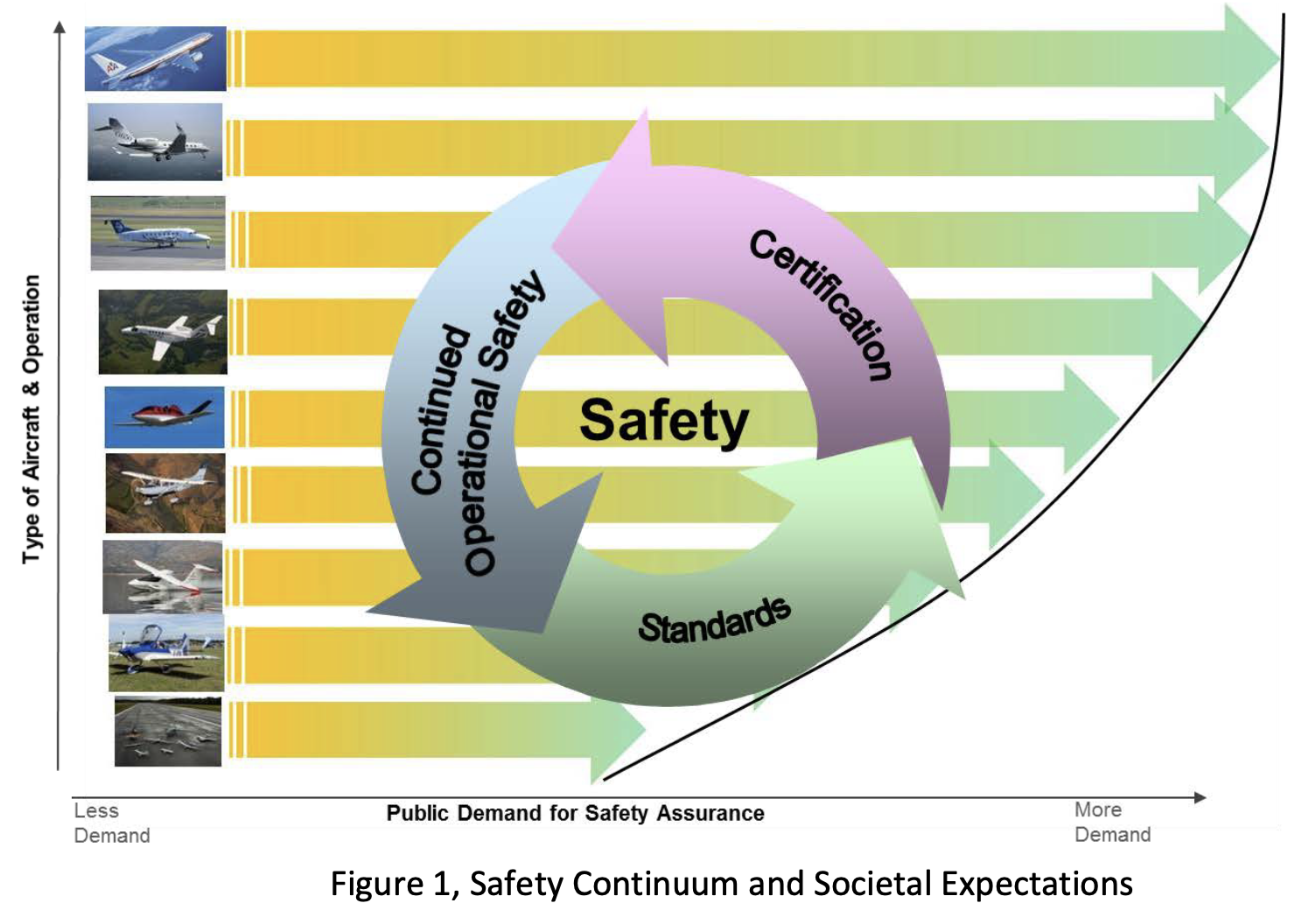
The reason I am so passionate about this issue is that, regardless of the final results of the accident investigation, my career is focused on our mandate to work across a complex system of systems – including the ever more congested airspace coordination of military and civil combined operations – to bring new technology faster in safety critical systems. Straight to the point, we have a two-edged sword with safety – we can be reckless and act too fast, or we can spend so long staring at a problem that we fail to get key solutions fielded in a timely manner. In fact, this idea called “the safety continuum” is a core concept in the FAA and its counterparts in the defense safety qualification organizations. The graphics below are extracted from that 2014 concept document.

The Army’s ADS-B Gap: A Budgetary Oversight
The Federal Aviation Administration (FAA) mandated in 2010 that by January 1, 2020, all aircraft operating in controlled airspace must be equipped with ADS-B Out to enhance air traffic situational awareness and prevent collisions. Airlines and commercial operators complied. Many general aviation pilots equipped their aircraft with the necessary upgrades. However, military aircraft were granted exceptions, and despite years of warnings and available technology, the U.S. Army has failed to fully modernize its aviation fleet to meet this standard. Many Army helicopters, including the UH-60 Black Hawk, still operate with legacy transponders that do not provide ADS-B functionality. Without this required upgrade another accident, one that is clearly avoidable, may occur. The Army Program Manager (PM) for Aviation Mission Systems and Architecture (AMSA) has a plan to upgrade Army Aviation’s fleet with ADS-B ready to execute today. PM AMSA is one of the organizations responsible for “cross-cutting” capabilities, like transponders and radios that go on every platform. This PM has by far the lowest approved budget of any program office in Army Aviation. OK, so we know there is a good reason for funding new programs – and we must do so – but that is no excuse for starving the very programs that provide FLEET WIDE CAPABILITIES that could save time, money, and most importantly lives by consolidated spending on things every aviation platform needs – like ADS-B transponders and newer radios to replace the legacy mission systems.
The Basic ADS-B Lightweight Source Archetype (BALSA) application, which I helped develop over a decade ago, demonstrated how an open architecture approach could rapidly and affordably insert ADS-B into military aircraft (note: we later renamed “ADS-B” to “Avionics” for BALSA because ADS-B was so obscure to the average new person). This open-source solution was created as part of the Future Airborne Capability Environment (FACE) Technical Standard and open systems initiative to introduce new suppliers in defense aviation, which promotes modular and interoperable avionics. Since that time, we have progressed even further and have active Small Business Innovative Research (SBIR) solutions available today that remain UNFUNDED in spite of both the legal requirements for a Modular Open-System Approach (MOSA) and civil navigation. In fact, the new approach, outlined in an award-winning paper for the IEEE Digital Avionics Systems Conference (DASC) describes in detail how modern microservice architectures can be used to safely, rapidly, and affordably insert new technologies into legacy avionics.
Additionally, the UH-60V upgrade program, which successfully demonstrated the rapid and affordable integration of Required Navigation Performance/Area Navigation (RNP/RNAV) on Black Hawks, provided a pathway to include ADS-B across the fleet. However, this program was defunded in subsequent Army budgets. While that program cancellation was perhaps prudent compared with other Army priorities, what is worse is that we have failed to transition this lesson of rapid acquisition and insertion of readily available MOSA application of Commercial Off the Shelf (COTS) civil navigation equipment on the remainder of the fleet. There are very few dollars available in defense budgets apart from whole programs like the UH-60V, so when we look at capabilities that apply to multiple aircraft, such as efforts to upgrade military transponders with ADS-B capabilities, these have been delayed and underfunded. [specifically: Aircraft Procurement, Army (APA) Program Line: Comms, Nav Surveillance (Line 019 – P-1 Line 8659AA0723) was cut from $164M in FY20 down to $101M in FY21, & even down further to $58M in FY22. The POM for FY26 onward has it only at $38M annually.] We do not provide our Acquisition Professionals the budgetary freedom to make common sense decisions because of the Program Element (PE) funding constraints put on program offices to manage “whole programs” – making it challenging to implement the pressing legal requirements for MOSA, as pointed out in a recent GAO report.
The result? An outdated fleet, forced to operate in shared airspace without the very technology designed to prevent mid-air collisions.
Future Tragedy Must Be Avoided
While we don’t yet know whether the lack of ADS-B was a direct cause of the DCA collision, its absence highlights a broader systemic issue in Army Aviation, and really across the entire defense ecosystem. The tragedy raises critical questions:
- Was the Army Black Hawk equipped with ADS-B? Even if this aircraft was, our airspace is getting ever more congested, and we must move quickly to equip the rest of the fleet!
- If not, would ADS-B have provided the necessary situational awareness to prevent the collision? Even more so, if ADS-B is just one step in a larger question of how we handle future congested airspace, we must still move rapidly to ensure that whatever new technology comes, perhaps as a direct result of this accident investigation, that we can get it on Military aircraft with the speed and agility we have proven is possible by applying MOSA principles.
- Why has the Defense Department failed to implement a straightforward, cost-effective modular safety upgrades standard in civil aviation? Now, this is very important to me having worked shoulder to shoulder with the program acquisition teams for much of my career – THE PROBLEM CAN ONLY BE FIXED BY CONGRESS! The way we appropriate, allocate, and obligate funding is working against the rapid insertion of modular technology EVEN THOUGH we have a legal requirement to do it. We must embrace “capability based” funding lines to augment our Program Element (PE) funding lines for whole platforms going forward to allow for the budgetary freedom to insert common sense horizontal capabilities.
These are not rhetorical – we MUST get into a real dialogue about this. They are life-and-death issues that must be addressed at the highest levels of military leadership and congressional oversight. No airline in the world would be given a pass for failing to install required navigation equipment due to budget constraints. So why do we accept this for military aircraft that share airspace with civilian aircraft?
Stop De-Funding Navigation and Radio Upgrades for Army Aviation
The technology to address this problem already exists. The MOSA-enabling solutions work we’ve done in Army Aviation has paved the way for rapid capability insertion at an affordable cost. This issue goes all the way back to a different regrettable fratricide incident in the mid 1990’s where transponder issues were investigated as part of an Army Aviation interoperability concern with the USAF. We must be able to build rapidly upgradeable and interoperable components across our system-of-systems. The problem is not technological—it’s budgetary and bureaucratic.
The Army must prioritize and fully fund:
- Transponder Upgrades – Equipping all Black Hawks and other operational Army aircraft with ADS-B Out is non-negotiable for safety.
- Civil Navigation Modernization – Allocating budget for a persistent cross-cutting capability for “standing requirements” such as the RNP/RNAV program would ensure our helicopters can operate seamlessly in civilian airspace regardless of platform-specific requirements (e.g. the PE issue).
- Open Systems Implementation – Fully embracing MOSA principles would make these upgrades faster, cheaper, and vendor-agnostic.
Congress, the Pentagon, and Army leadership must understand that this is not just a funding issue—it’s a safety issue. It’s about ensuring that our military pilots, crews, and passengers, as well as the civilians they share the skies with, are not put at unnecessary risk due to outdated equipment and budget shortfalls.
Final Thoughts
The tragic loss of life in the DCA mid-air collision is a stark reminder of what’s at stake. The Army has long delayed upgrading its aircraft with the necessary civil navigation tools despite having the technology, expertise, and proven success stories to do so affordably.
We must correct this oversight before another tragedy occurs – civil navigation for Army Aviation should never be a budgetary afterthought. Furthermore, if we cannot do something as simple as strapping on COTS civil aviation, how much more the risk we cannot respond to evolving threats on the future battlefield. Funding for the business side of MOSA to enable cross-cutting capabilities cannot wait for other people to understand the technical issues their Subject Matter Experts have been telling them for decades.
LEAD, FOLLOW, OR GET OUT OF MY WAY!
I want to encourage the leaders who are working with me to engage in MOSA as a foremost priority, get behind capability based funding, and be bold enough to act on common sense. If you are in that space and don’t feel like you have the power to make a difference in a leadership role, that does not make you passive – following also involves echoing this and support for those common sense actions – we need to get the collective voice heard. This is the time to roll up our sleeves and help work out the business case for what we already know how to do technically. For those In the Way: MOVE OVER!
 Exocubic
One Comment Add yours