When J. R. R. Tolkien published The Lord of the Rings, many readers assumed they were looking at a political allegory. The generation that had lived through the Great Wars could not help seeing the shadows of their own experience in Middle Earth. Armies rising in the East, old alliances strained, ancient evils returning after long years of uneasy peace. Tolkien himself resisted those interpretations. He insisted that the story was not written as commentary on current events. It came from something deeper. His work grew out of language, myth, and long study of the nature of good and evil. The result felt familiar because the patterns he described were older than any one conflict.
While reading an article in the Economist regarding the potential for escalation in the abruptly started war with Iran, I saw in the smoke of the image two opposing ideas. I could vaguely make out the image of those old time paper silhouettes in the clouds, Lincoln idealizing the Western concepts after our own Civil War that set about a pattern of justice and peaceful restraint in order to build a brighter future. It is an indelible part of the American experiment. In the other cloud, a very different worldview is juxtaposed, one that we would be sorely mistaken in conflating with just the modern sentiment of Marx and Lenin. The centuries old experiments of collective dynastic rule has co-opted both Socialism and Capitalism in what emerges from the East. In fact, our use of the term “Cold War” was not from the creation of East and West Berlin, it dates earlier than 1939; it came into more common use a decade later, after the borders of Communism spread, driving the rapid exodus of the Chinese pre-war leadership to their new home in Taiwan. Most Americans alive today do not know this full history of the term Cold War, it is just a footnote in our history books.
I reimagined what it would look like if Tolkien or Lewis had written an article for a 1950’s newspaper and the staff cartoonist drew that photo as a political commentary. Since I do not have such a staff cartoonist, I prompted for it to get my own cover art.
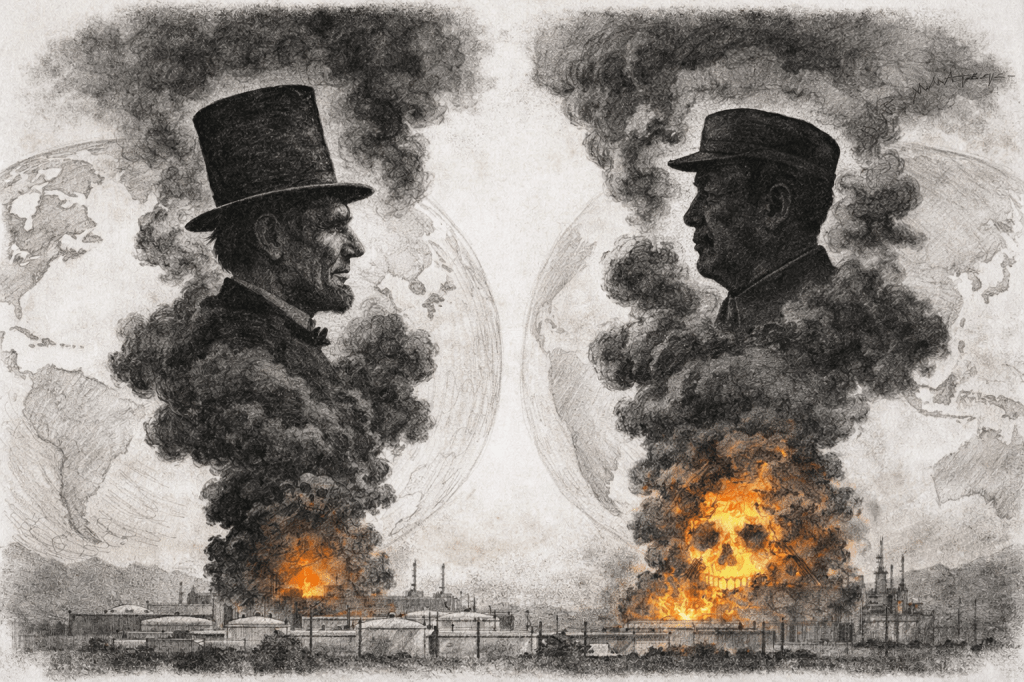
The power with which we can move is staggering, albeit so quickly overshadowed by the next prompt. So I decided to take the time to write out the thought rather than just regenerate the image. Slow thinking is rare these days.
Like Tolkien’s work, the edges of the fragile peace in the world have plenty of regional conflict. Enough to make people ignore the smoke and occasional flashes of little wars amongst neighbors. The power of the story lies in the way darkness returns. It does not arrive with a declaration. It gathers at the edges. Those who live inside the peace of an established order tend to believe that the worst lessons of history have already been learned. The wars of the past become proof that humanity will not repeat them. Those who govern in such times spend their effort managing the visible problems of the present. The deeper movement of events remains unnoticed until it is too late to treat it as a distant concern. During the Cold War, we believed that the threat of escalation would build deterrence. Are we still so certain?
In recent years I have found myself thinking about that pattern more often. What began as an intellectual exercise has started to feel less theoretical. The thought first took shape during a briefing I gave last winter to a group of senior defense and industry leaders. The subject was technological convergence. Artificial intelligence, distributed trust systems, advanced manufacturing, and modular architectures were all developing at the same time. Each field alone was significant. Together they suggested something larger. A change in the structure of power itself.
Much of the run-up discussions of the last decade felt like preparation for a future that would arrive gradually; those of us with one eye on history and the other on technology warned that it would come, as most transitions do, far more abruptly. My briefing in November 2025 to a closed audience in an undisclosed think tank was calm, discussing the impacts of Acquisition Transformation and how various impacts would be absorbed by the various parts of the American defense industrial complex. It was late in the year, the season when people assume that the next crisis will come later, well after the holidays, well after the next budget cycle, perhaps after the next election.
The war in Ukraine continued without resolution, yet like the proverbial frog in the pot of water, most Americans have largely discounted that news feed. Tensions in the Middle East rose and fell after the Hamas conflicts with Israel resulted in some quick actions followed by an uneasy calm. I had always meant to write the article from my journal notes that the Hebrew word for “violence” is ḥāmās [H2555]* (as in 2 Sam 22:3), a term co-opted as an acronym for a modern adversary to those speaking the Hebrew language. Think about it, every time a native Hebrew speaker would say something in English like “we have been in negotiations with Hamas,” they quietly knew that it was an insulting inside-joke that they would never reach a peaceful outcome, “negotiations with violence”. It is also translated “injustice,” and Lincoln would not have fallen for the joke. Again, most Americans have no idea what is really happening in the rest of the world. Then the conflict with Iran broke open with a speed that surprised even those who expected trouble. Will this one escalate, or simply dull back into a slightly elevated temperature that our Amphibious-Americana mistakes for Pax?
The details of any one confrontation matter less than the pattern they form. What stands out now is the sense that several long cycles may be lining up at once. For some time I have described this alignment with an obscure reference conjoining two ideas that usually live in separate spheres of conversation. The first comes from Alvin Toffler’s description of the transition from industrial society to an information driven civilization in his seminole work “The Third Wave” published just before 1980. The second comes from Strauss and Howe’s generational theory, published prior to Y2K, introducing the idea of a “Millennial Generation,” and suggesting a four-phased rhythm that societies move through. This recurring set of “generational moods” ends in periods of crisis and reconstruction, such as the American Revolution, the Civil War, and WWII. Toffler’s Second Wave was the Industrial Revolution, slightly out of sync with the two 4th turn crises that resulted in the conflicts of those generations. The Third Wave is an Information Revolution, one that no one doubts is converging in this same season. When the Third Wave of technological change meets a Fourth Turning of social strain, the pace of history is not simply going remain steady and ride the wave.
The resulting acceleration will likely become more intense when new technologies (my convergence discussion of AI + Block Chain + Advanced Manufacturing + MOSA) magnify the transition instead of merely accompanying it. Artificial intelligence changes how decisions are made; we are moving away from the all-night penmanship of serious leaders wrestling with speeches from all human history in the past, when society once listened, hanging on every word, to the voices of reason. That was four-score and some time more ago. Consequences are faster, so we need faster decision cycles, or so we tell ourselves as we act more like parrots than philosophers when engaging large language models. At least the GPT chatbots read the history books, so the parrots are saying the words that sound like thoughtful commentary. However, those of us in computer science that have been paying attention realize that AI/ML is not to be conflated with just language models, the real convergence is the integration of a whole set of technologies that read images, interpret data, and recognize patterns; this form of AI/ML is far more mature than its Generative Pre-trained Transformer younger sibling. The power of that language integration, as one of my associates pointed out at a Summer 2025 Chief Architect Network event, is that LLMs are like the new “user interface” to all that other, often far more mature, technology. It can help us move from intent (expressed in language) to action (expressed in more complex things like code, cryptographic trust, digital manufacturing, and modular design) at a speed that many feel humanity is not ready for. Quantum computing will push that beyond the limits of thought, our computational systems will begin to move into real world application faster than we can build any kind of constraint. Conversely, our social systems were built for a slower world struggle.
Let me say it this way: 10 years ago, a single individual with a radical idea had to devise a strategy, gather the data, build a secure way to include other elements to their radical idea, manufacture prototypes, redesign / refactor those prototypes so they can be built at scale, figure out how to modularize that to outsource production, and then push that approach into action. That radical idea could be a new start company, a new form of healthcare, a new way to educate underprivileged neighborhoods, or it could also be inspired by [H2555]. Today, that same radical idea can be done in a fraction of the time. I have a saying, one of my “John-isms” that I subtly hope others will copy when they hear it: “Human physics follow different laws – for each and every social action, there is an unequal and opposite overreaction.”
The present moment carries the feeling of such a convergence. History has seen upheavals before. I keep hearing the word “unprecedented” and am starting to grow numb to it; the word unprecedented itself has lost its force through repetition. What makes this period unsettling is not that change exists, but that change is occurring at several levels, at the same time, at a pace that our slower social system and philosophical underpinnings cannot quite handle. We run with very different social over-stories, to invoke Malcom Gladwell’s use of the term in Revenge of the Tipping Point, when considering Western and Eastern philosophy. Political tension, demographic pressure, and technological transformation are moving together in both the West and the East. The problem is, although they are synchronizing (as Neil Howe likes to point out), they are not, in their foundations, compatible.
The United States has lived for many decades under the assumptions of the postwar order. After the Second World War the country reorganized itself around the idea of permanent defense rather than permanent war. Even the name of the War Department disappeared, replaced by the Department of Defense, as if the act of renaming could signal the arrival of a more stable era. The nuclear balance reinforced that belief. Mutually assured destruction created the sense that any future conflict between great powers would end so quickly that prolonged war belonged to the past. That assumption shaped the habits of government, industry, and public life. Procurement cycles lengthened, post-cold-war drawdown slowed innovation, and what we think of as entrenched bureaucracy is really only a brief footnote in the history of innovation in warfare. The idea of a sudden, society-wide mobilization came to feel like a relic of another age, something like the period Billy Mitchell warned about regarding Pearl Harbor in 1924. Remember that the war over another island, to the East across the pond, had been raging for some time prior to that event that catapulted the USA to arms.
We built up a social confidence that the rest of the “First World” was too enlightened to fall back into armed conflict; it is all policing actions and regional warlords on the edges of civilization. We watch movies about the Cold War and somehow those little regional conflicts of the past that were tied together by James Bond like intrigue appear to us as distant as the writings of Charles Dickens. The frog was enjoying the sauna for the moment, cheap toys and limited commitments. Recent changes suggest that this confidence may have rested on conditions that no longer exist. Conflict now unfolds in ways that do not fit the model of the Cold War. Technology proliferation is no longer limited to well controlled items like nuclear power, itself already spilling beyond the historically limited borders; for anyone that has read “The Bomber Mafia”, you will realize that it does not take a nuclear bomb to set a countryside ablaze. Smaller actors can gain access to tools that once belonged only to major states, far below the level of control of nuclear destruction. We may have missed the memo on what the Third Wave revolution was titled. Information moves across borders without permission and security checkpoints.
Some students of strategy, myself included, have long believed that a wise adversary would avoid the kind of shock that united the United States after Pearl Harbor. I remember first reading the Fourth Turning in the shadow of 9/11 after an interview with Neil Howe explaining why that event did not fit the criteria, the generational mood was all wrong. The world rallied together, the crisis had not yet come, and the old social order was still in twilight. Students of defense acquisition reform will realize (as pointed out on Nov 7th by SecWar) that we were just about to implement a new strategy for technical modularity and then, all at once, we shifted our attention away from preparing for the change in threat pictures that futurists were predicting and instead fell into a unit-economic trap of trading Tomahawks for Toyotas in counterinsurgency. Meanwhile, the lesson drawn from the twentieth century was simple: Let the giant sleep. A wise adversary boils the pot slowly, engage the capitalist love of consumer price index, apply pressure at the edges in real estate procurements, encourage outsourcing of complex specialization, use proxies to avoid direct confrontation, exploit social divisions. Advance without crossing the line that forces a single decisive response. We have arrived.
This is the reason I am writing the article now. I was thinking it would come around the time of my holiday break after November, when I normally take a day or two to gather my notes and thoughts to reflect and think ahead for the next year. I have been preparing for a decade to write a journal entry in November of 2026. After all, I am in no way surprised by the closing of the Davidson Window. I find myself feeling pressed to write this sooner than I anticipated, as fits the character of the present era of acceleration. The conflict with Iran does not stand alone. The war in Ukraine does not stand alone. The war on Cartels, you guessed it, does not (despite all appearances) have as much in common with drugs as it does with proxies; perhaps it was not just politically expedient to frame narco-terrorism as proxy non-state actors for a new form of global tension. Perhaps. What else do we see if we broaden the aperture? Do tensions in the Pacific stand isolated from these global events? Each looks local when viewed in isolation. The center of gravity is difficult to see because it does not sit in one place. However, it would be a mistake to think this is simply a contrived set of conditions. When tectonic plates clash to form a tsunami, they did not conspire towards it.
Even so, the differences in philosophy are not innocent in the desired post-transition results. Wise leaders on any side of such a well understood looming transformation in geopolitics are continuously recalculating their odds of limiting liabilities while maximizing returns. This is where the comparison to Tolkien’s world becomes useful again. We live in a world where we think of our neighbors as conspirators, failing to notice the darker clouds on the horizon. In Middle Earth, the return of danger did not begin with open war. It began with small signs that could be dismissed, localized tensions that could be dismissed. Old alliances weakened while strange rumors spread. Travelers reported shadows in places that had long been quiet, while those at the pub either fell into anxiety or ignored it and kept on drinking. Those responsible for keeping order had reasons to focus on immediate problems, after all keeping the peace is the job of stewards; no need to waste budgets on armies at peacetime. One morning the world awakes and the larger shape of events becomes clear, the world had already changed.
Strategists have been looking further East for some time now, anticipating coming pain in a different global trade choke point. However, the Middle East today carries some of that atmosphere of the early skirmishes in Middle Earth. What an easy distraction from where the progression of history thinks it is taking us. Or have both sides miscalculated? The region has always been unstable, but the current instability feels connected to forces beyond its borders. When violence erupts there, the effects travel far beyond the battlefield. The smoke rising from a refinery can be local, but the consequences are global. In this case, perhaps more than we first realize. We may not be able to put this genie back into its Arabic bottle. Who knows, perhaps I am just hyperbolic.
So what, then, do we make of future planning in a converging technological epoch? The long cycles of history are quickly shortening; this does not guarantee catastrophe, but it does narrow the margin for error. A generational crisis makes societies less patient, less isolated, and perhaps less resilient; we shall see. This is the possibility that has occupied my thinking for several years. The briefing I gave last winter was meant to describe the technological side of the change; that particular room was already intimately familiar with the geopolitical and social transformation. Some of us were anticipating the Third Wave in certain circles of thinking. Some others of us are tracking the latest Fourth Turning. Both of those are likely unfamiliar thoughts to the technologists who are simply enamored with the fallacy of linear progression of society while also captivated with the idea of an AI singularity. The convergence of these ideas deserves more attention than it is receiving.
It may still be possible to pass through this period without a single defining shock. I still do not think the modern catalyst will come in a Pearl Harbor like event; but the catalyst for change always comes. A semi-famous project management-ism is that we transform a system when the pain of staying the same exceeds the pain of the change we knew we needed. History offers examples of transitions that unfolded slowly enough for institutions to adapt after some catalyst forced a redevelopment of the old system. We can call to mind some recent examples where we have made it through a crisis, for better or worse for the change. And yet neither the Book of Eli nor the Thunderdome have yet come to pass. History also offers examples of moments when the pace outran the ability to respond. The library that once was in Alexandria is no more. Some civilizations we know of only because of their artifacts. The difference often becomes clear only after the fact, indeed.
For those who study these patterns, the present time carries the uneasy feeling of Bilbo and Gandalf comparing notes. Ah, no worries, this is a birthday party! For us, it is celebrating 250 years, over twice Bilbo’s claim! Storms have passed before. Perhaps I am just seeing a Rorschach illusion in the smoke. Perhaps.
*Footnote: for those familiar with the principle of first use in hermeneutics, there is more going on here than the jesters of violence in the play on words are aware of. That, however, is a theology discussion for the pub.
 Exocubic